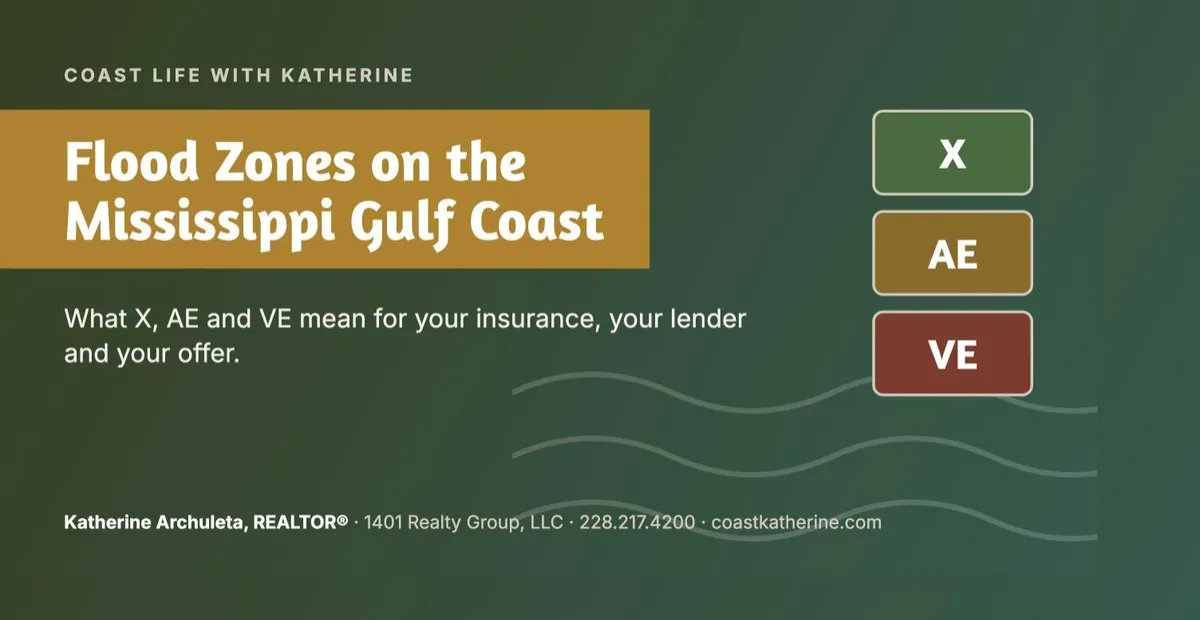
Flood Zones on the Mississippi Gulf Coast Explained: X, AE and VE
Short answer: on the Mississippi Gulf Coast, the flood zone printed on FEMA's map tells you how likely a property is to flood, whether your lender will require flood insurance, and how your premium may be priced. Zone X is lower risk, Zone AE is the 1%-annual-chance floodplain, and Zone VE is the coastal high-hazard area where waves are expected. Check the zone before you write an offer, not after.
What the flood zone letters mean
Zone X (unshaded): minimal flood hazard on FEMA's map. Flood insurance is usually not required by lenders, but floods still happen outside mapped zones.
Zone X (shaded): moderate hazard, roughly the 0.2%-annual-chance ("500-year") floodplain. Insurance is usually optional and often less expensive.
Zone AE: a Special Flood Hazard Area with a 1% chance of flooding in any year and a published Base Flood Elevation (BFE). If you have a federally backed mortgage, flood insurance is required.
Zone VE: the coastal high-hazard area, where storm waves are expected on top of the flooding. Building standards are stricter and insurance usually costs the most. Flood insurance is required with a federally backed mortgage.
How to look up a property's flood zone
Go to FEMA's Flood Map Service Center at msc.fema.gov, type in the address, and open the dynamic map. You'll see the zone and, in AE and VE zones, the Base Flood Elevation. Cities and counties also keep local flood map information, and your agent or lender can order a flood zone determination.
Why the elevation certificate matters
An elevation certificate, completed by a licensed surveyor, shows how high the lowest floor of the home sits compared with the Base Flood Elevation. A home built well above the BFE can be much cheaper to insure than one at or below it. Ask the seller if one is on file. If not, a surveyor can complete one, and it can be worth the cost before you commit.
Flood insurance basics for Coast buyers
Regular homeowners insurance does not cover flood. Flood coverage is a separate policy through the National Flood Insurance Program (NFIP) or a private insurer.
NFIP policies generally have a 30-day waiting period, with an exception when the policy is bought in connection with a new loan at closing.
NFIP premiums are now based on each property's individual risk (FEMA's Risk Rating 2.0), so two homes on the same street can have very different prices. Get a real quote early.
On the Coast, budget for wind and hail coverage too. Named-storm deductibles are often a percentage of the home's insured value.
Your quick checklist before you make an offer
Look up the flood zone on FEMA's map.
Ask the seller for an elevation certificate and any flood claims history.
Get flood, wind and homeowners quotes and add them to your monthly payment.
Make sure your offer gives you time to finish insurance shopping.
Thinking about buying on the Coast and want help running the numbers, insurance included? Call or text Katherine at 228.800.0012.
Katherine Archuleta, REALTOR® | 1401 Realty Group, LLC | 228.217.4200 | Ocean Springs, MS. This article is general information, not insurance or legal advice. Flood maps and insurance rules change; confirm details with FEMA, your insurance agent and your lender.